How to Choose the Right Battery Size for Your Home
Battery sizing is about your evenings, not your roof
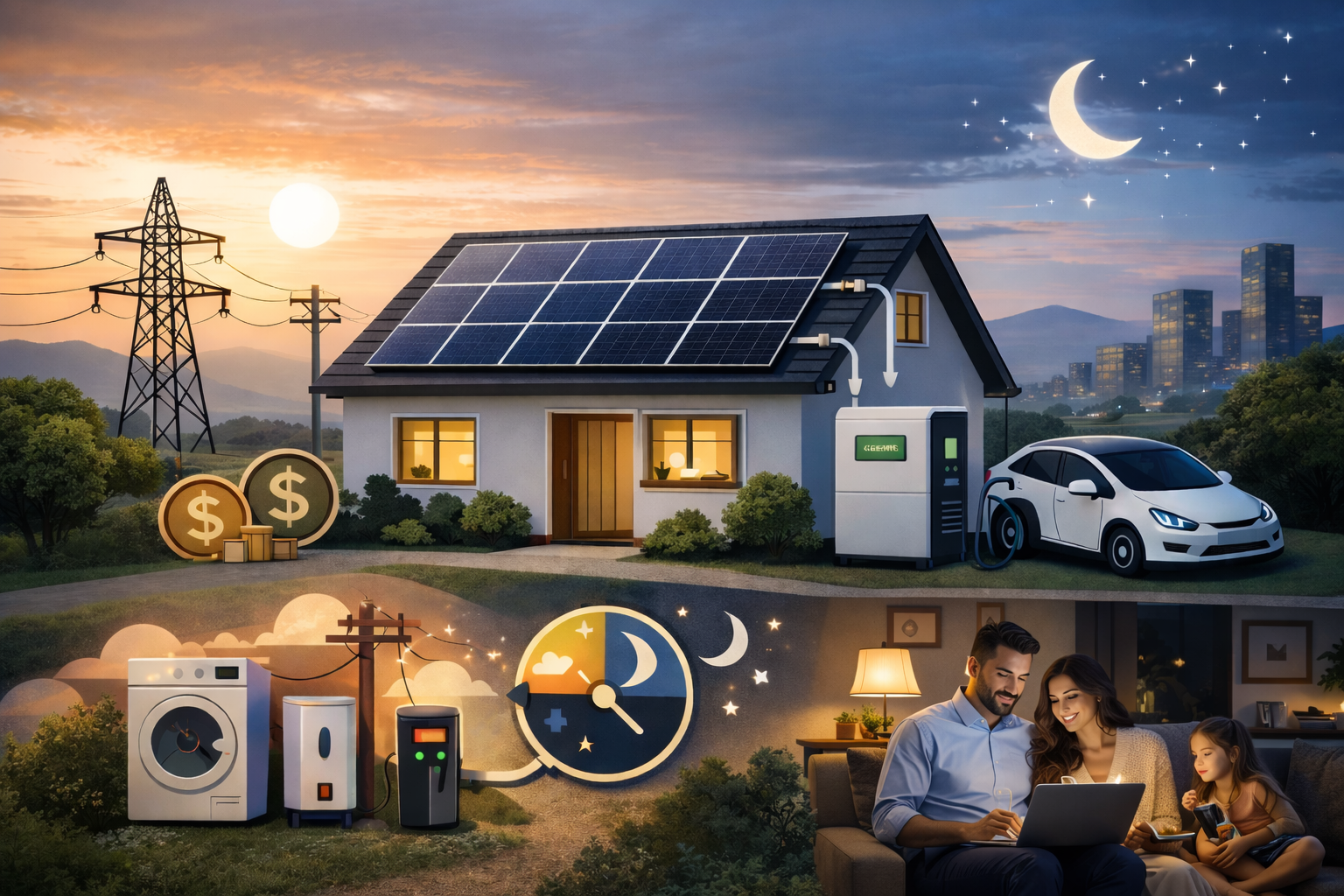
A home battery is not just a box that stores solar. It is a tool for shifting energy from when it is generated to when you actually need it.
For most households, that means covering the evening period: cooking, heating or cooling, lighting, and the background loads that never stop.
Choosing the right battery size is a balancing act between how much energy you want to shift, what you want during outages, and what makes sense financially.
Two numbers you must understand: kWh and kW
Battery specs get confusing because two different units sit side by side.
· kWh (kilowatt-hours) is the amount of energy stored. Think of it as the size of the fuel tank.
· kW (kilowatts) is the power the battery can deliver atany moment. Think of it as how wide the tap is.
A battery might have plenty of energy (kWh) but still struggle to run high-power appliances if the power rating (kW) is limited. Both matter, especially for backup.
What can a battery run, realistically?
People often think of battery sizing as a simple runtime calculation. In real homes, the limiting factor is often power, not energy.
A kettle, toaster, oven, and ducted air conditioning all draw a lot of power. A battery may have enough stored energy to run them for a while, but if the power draw exceeds what the battery and inverter can deliver, the system will limit output or trip the protected circuits.
This is why backup planning usually focuses on critical loads rather than whole-home backup. It is also why it is important to discuss which appliances you want to run at the same time, not just how long you want backup for.
Step 1: Estimate your evening and overnight usage
The most practical starting point is your electricity use from late afternoon through the night. If you have smart meter data, look at something like 4pm to 8am. If you do not, you can still make a useful estimate.
Consider:
· Cooking and kitchen loads in the evening.
· Heating or cooling after the sun goes down.
· Laundry habits and whether they can be shifted into the day.
· Hot water type: resistive electric, controlled load, or heat pump.
· Background loads: fridges, networking gear, standby devices.
If your evening use is relatively low, a large battery can end up under-used. If your evening use is high, a small battery may empty quickly and stop doing much after dinner.
Step 2: Be clear about the goal
Different goals point to different battery sizes and sometimes different hardware.
Bill reduction and self-consumption
If your main goal is reducing bills, the battery should be able to capture a meaningful portion of your typical midday excess and then cover a solid slice of evening demand.
This is where right-sizing matters. Too small and it fills quickly then you are exporting again. Too large and it rarely fills, so you are paying for capacity you do not use.
Backup power during outages
If you care about backup, ask two questions: how long you want to run, and what you want to keep running.
Most homes do not backup everything. A practical backup plan focuses on critical circuits such as:
· Fridge and freezer
· Lighting
· Internet and basic power points
· A small amount of heating or cooling, depending on the setup
· Medical equipment if relevant
High-power loads like ducted air conditioning, ovens, and EV charging may be limited or excluded from backup depending on system design. This is normal.
Peak pricing and time-of-use tariffs
If you are on a time-of-use tariff, the battery can reduce imports during expensive peak windows. Sizing depends on how long the peak period runs and your typical consumption during that time.
Some households also use batteries to charge during cheaper periods and discharge during peak. Whether that makes sense depends on the tariff spread and how the system is configured.
AC-coupled vs DC-coupled: why it matters for upgrades
If you are adding a battery to an existing solar system, you may hear terms like AC-coupled and DC-coupled.
· AC-coupled systems connect the battery through its own inverter. They can be practical for retrofits because the existing solar inverter can often stay in place.
· DC-coupled systems typically share a hybrid inverter, which can be efficient and neat for new builds or full system replacements.
There is no universal best choice. The right approach depends on what you already have, what you plan to add later, and how you want backup circuits configured.
Usable capacity vs nameplate capacity
Many batteries are marketed by their total capacity, but what matters is usable capacity. Most systems reserve some energy to protect the battery and ensure stable operation.
When comparing options, ask for the usable capacity (kWh) and the limits on depth of discharge. It is the usable portion that powers your home.
Match the battery to your solar systemsize
A battery needs energy to store. If your solar system is small or your daytime use is high, there may not be much excess solar available to charge a large battery.
As a rough principle, battery size should be chosen alongside solar size, not in isolation. The goal is a system that fills the battery often enough to be useful, without constantly overflowing into exports.
Example household scenarios (to help you sanity check)
No two homes are identical, but these scenarios show how the decision shifts.
· Small evening load: a household that cooks lightly and has modest heating or cooling may only need enough storage to cover lighting, refrigeration, and general power points. A huge battery will often be wasted capacity.
· High evening load: a family running air con into the evening, cooking nightly, and doing laundry after work may need more storage to noticeably reduce peak imports.
· Backup-focused: a household in an outage-prone area may prioritise the ability to run critical loads for longer rather than chasing maximum bill reduction.
An installer should be able to explain which scenario you most closely resemble and why.
Export limits can make batteries more valuable
If export limits apply at your property, you may find that excess midday energy is capped. A battery can capture some of that energy and shift it into the evening, improving the usefulness of your solar system.
This is one of the more practical reasons batteries can make sense even when feed-in tariffs are modest.
Summer, winter, and realistic expectations
Battery behaviour changes with the seasons because solar production changes.
· Summer: longer days can mean more solar excess and more opportunity to fully charge the battery.
· Winter: shorter days and higher household loads can mean the battery charges less often and empties faster.
A good design sets expectations for winter. If a battery only fully charges on the best summer days, it is likely oversized for your current setup.
EVs and electrification: plan ahead
If you plan to add an EV, heat pump hot water, or switch off gas cooking, your electricity demand will change. That can change both the best solar size and the best battery size.
The simplest approach is to map what you are likely to add in the next two to five years and designfor that pathway. It often avoids rework later.
VPP participation: it can influence the right size
If you join a Virtual Power Plant (VPP), your battery may be used to export energy to support the grid during certain events. That can change how full the battery is at different times and may affect how you prioritise backup versus bill reduction.
Not everyone wants a VPP. If you do, it is worth designing the system around how you want the battery to behave day to day, not just what the brochure promises.
A practical sizing workflow you can follow
1. Estimate evening and overnight usage using interval data if available.
2. Decide your primary goal: bill reduction, backup, or peak price management.
3. Check whether export limits apply and how often you export solar today (if you already have solar).
4. Confirm your solar system has enough excess to charge the battery reliably across seasons.
5. Choose a battery size that will cycle regularly without being empty by early evening most days.
If you want to sanity check a recommendation, ask the installer to explain what the battery will look like on a typical winter weekday. That answer is often more revealing than a summer output estimate.
Battery lifespan, degradation and warranties
Batteries slowly lose capacity over time. This is normal. The key is understanding what the warranty actually covers and how that lines up with your expectations.
Warranties commonly include a time period and a throughput or cycle limit, plus a minimum remaining capacity at the end of the warranty period. These details matter more than marketing phrases like “long life”.
When comparing battery sizes, remember that a battery that cycles hard every day may reach its throughput limit sooner than a larger battery doing lighter daily cycles. Again, the goal is a size that matches your real usage and the way you plan to operate the system.
Questions to ask before you sign
· What is the usable capacity, not just the headline capacity?
· What is the continuous power rating and what loads will it support?
· Is the system designed for backup, and if so, what circuits are included?
· How will the battery behave in winter when solar production is lower?
· If I add an EV later, what changes would you recommend?
Clear answers are a strong signal you are dealing with proper system design rather than aone-size-fits-all approach.
Bottom line
The right battery sizeis the one that you will actually use most days. It should fill often enough to matter, discharge in a way that matches your household’s peak periods, and support your backup goals if that matters to you.
If you size the battery around real usage patterns, you usually end up with a system that performs well across seasons and still feels sensible years down the track.