Solar & Battery Insights
for Smarter Energy Decisions

ACT Solar, Battery and Electrification Rebates Explained (Canberra and ACT)
Why ACT incentives are different
The ACT has a strongtrack record on electrification policy, and the incentive landscape reflects that. Instead of relying only on cash rebates, the ACT has leaned heavily on finance schemes and structured programs that support efficient electric upgrades.
That matters because many of the biggest barriers to electrification are upfront cost and decision complexity. A well-designed loan scheme can remove friction without encouraging rushed purchases.
Important note before you plan around incentives
Incentive rules change. Eligibility can depend on household circumstances, property type, and the specific product being installed.
The safest approach is to treat any article like this as a starting point. Before you sign a contract, confirm the current rules on the official ACT program pages and check how they apply to your situation.
The core ACT program: Sustainable Household Scheme (SHS)
The Sustainable Household Scheme is one of the most visible ACT programs. It is designed to help eligible households finance energy upgrades with a low-interest loan structure.
As of early 2026, the scheme is commonly described as offering loans capped at a fixed maximum and set at a published interest rate for new loans. Eligibility and the list of approved products are defined in the scheme guidelines, and those details are worth checking before you commit.
Sustainable Household Scheme: what’s on offer (as of February 2026)
At the time of writing (Feb 2026), the Sustainable Household Scheme is widely described as a low-interest loan program for eligible ACT households, with loans offered within a set range and capped at a maximum amount. The published interest rate for new loans is stated in the program information, and the loan term can vary depending on the scheme rules.
One detail that catches people out is that the scheme settings have changed over time. For example, the ACT has publicly noted changes that took effect from 1 July 2025, including an interest rate applying to new loans and changes to whether solar panels are eligible under the scheme for many households.
Because these settings can change, treat the published ACT guidelines as the source of truth when you are ready to apply.
Loan vs rebate: why the wording matters
A rebate reduces the purchase price with money you do not repay. A loan spreads the cost over time, which can still be helpful, but it is a different financial decision.
In the ACT, many of the best-known programs sit in the “low-interest finance” category. That can still be a big deal for households that want to electrify without paying everything upfront, but it is worth being clear about repayments before you commit.
What types of upgrades are commonly supported
Programs and eligible product lists can change, but ACT support has typically focused on the upgrades that make the biggest difference to electrification and energy use, such as:
· Home battery storage
· Heat pump hot water systems
· Efficient heating and cooling (reverse-cycle airconditioning)
· EV chargers
· Other efficiency-focused electrical upgrades where eligible
If you are planning a whole-home pathway, these categories matter because they stack together. Solar helps produce energy. Batteries help shift it. Efficient appliances reduce the amount you need in the first place.
A practical pathway: solar first, then storage and electrification
For many ACThouseholds, the most practical pathway is staged.
1. Install solar first if the roof is suitable and you have daytime usage you can cover.
2. Add a battery when export limits, tariffs, and household usage make storage useful.
3. Tackle electrification upgrades like heat pump hotwater and heating or cooling as appliances reach end of life, or sooner if your household goals justify it.
This staged approach reduces risk. It also lets you use real data from your home to size the next upgrade properly.
Concession households and additional support pathways
The ACT has also referenced separate support pathways for concession card holders, including access to different loan conditions and, in some cases, access to solar funding outside the standard Sustainable Household Scheme settings.
If you hold a concession card, it is worth checking whether you are better served by a concession-focused program rather than the standard pathway. The rules can be more favourable, but eligibility and product lists still apply.
A key change to be aware of: solar eligibility can differ
ACT programs sometimes separate solar PV from other upgrades. For example, the Sustainable Household Scheme guidelines have changed over time, including changes to whether solar panels are eligible under the scheme for different household types.
If solar PV funding is important to your plan, confirm whether solar is currently eligible for you, and whether concession card status or other criteria change that outcome.
Brighte and ACT loans: what “loan partner” means in practice
In the ACT, Brighte is commonly referenced as a delivery partner for Sustainable Household Scheme loans. Practically, this means Brighte handles the loan application process, approvals, and repayments under the scheme rules and lending criteria.
For homeowners, the key takeaway is that there are usually two parts to eligibility:
· ACT program eligibility rules (set by the ACT Government and scheme guidelines)
· Lender criteria (assessed as part of the loan application)
A good installer can help you with quotes and technical choices, but the lender will still assess the application under their criteria.
Workshops and information sessions: not a box-tick exercise
Some ACT programs require an information session or workshop before you can access finance. It can feel like extra admin, but it is often useful if you treat it as part of your design process.
A good workshop outcome is clarity on what upgrade will actually reduce your grid imports. For many households, the best first move is not the fanciest technology. It is the upgrade that matches your daily usage pattern.
How the process usually works (high level)
While details canvary, the typical flow looks like this:
1. Confirm you meet the program eligibility requirements.
2. Attend any required information session or workshop if the scheme requires it.
3. Get an itemised quote for an eligible upgrade from a qualified provider.
4. Apply for the loan through the scheme’s delivery partner.
5. Once approved, proceed with installation and keep all documentation.
The order matters. If you install first and apply later, you may miss eligibility. Always confirm the required process before you commit.
How ACT incentives interact with federal STCs
If you are installing solar in the ACT, federal STCs commonly apply as an upfront discount for eligible systems. ACT programs then sit on top, often supporting batteries and electrification rather than duplicating the federal solar incentive.
This is why a whole-plan approach works well. You can design solar and storage together, then use ACT support to fund parts of the upgrade pathway where it delivers the most value.
Townhouses and apartments: what can be harder in the ACT
Multi-unit dwellings can still benefit from solar, batteries, and EV charging, but the decision process is often slower because of shared ownership and approvals.
· Strata approvals and common property rules can limit equipment placement.
· Metering and billing arrangements can affect how benefits are shared.
· Switchboard and feeder upgrades may be required for EV charging.
If you live in a townhouse complex or apartment building, early conversations with the owners corporation can save months. It is also worth getting advice on what istechnically possible before trying to align everyone around a specific product.
Common mistakes that slow approvals or cause headaches
· Signing contracts or paying deposits before confirming eligibility and required steps.
· Assuming a product is eligible without checking the approved list or current guidelines.
· Getting vague quotes that do not itemise the eligible components clearly.
· Not planning switchboard upgrades early, then discovering extra work is required.
A little upfront admin can save weeks of frustration later.
Canberra-specific design considerations
Canberra’s winters can be cold, and many households rely on heating. If your home uses reverse-cycle air conditioning for heating, winter electricity consumption can rise while solar generation drops due to shorter days.
This is why ACT households often benefit from a design process that models a typical winter week, not just summer output. It also makes efficiency upgrades like draught sealing and heat pump hot water more valuable because they reduce the total energy needed.
Batteries, VPPs and ACT households
If you install a battery, you may also have the option to join a VPP depending on what programs are available at the time. VPP participation can add a revenue layer, but it can also affect how much stored energy you have available when you need it.
If your priority is backup power, discuss how reserves are handled and whether participation can be limited or opt-out. Not every household wants the same battery behaviour.
Where to focus for the best long-term outcome
The ACT incentive landscape is most helpful when it supports a design-led plan. The best outcomes usually come from:
· Right-sizing solar to your roof, tariff, and usage profile
· Choosing battery capacity based on evening imports and export limits
· Prioritising high-impact electrification upgrades such as heat pump hot water
· Improving efficiency first so you need less energy overall
Incentives should make good decisions easier, not push you into rushed or oversized systems.
ACT incentives FAQs
These are the questions we hear most often from Canberra homeowners.
Is there an ACT solar rebate?
ACT support has included different programs over time, and the most common support people talk about today is finance through schemes like the Sustainable Household Scheme. Whether solar panels are eligible under a given program can change, so check the current guidelines for your household type.
Is the Sustainable Household Scheme arebate?
No. It is a loanprogram. It can still help with upfront cost, but you repay the amount borrowed under the loan terms.
Is Brighte the installer?
No. Brighte is a loan delivery partner for the scheme. Installers provide quotes and do the installation work, while the loan application and lending criteria are handled through the finance partner.
Can I combine ACT support with federal STCs?
Often yes, where applicable. STCs are typically applied as an upfront discount on eligible solar systems, and ACT programs may support other upgrades like batteries, EV chargers, or heat pumps. The exact combination depends on current rules and eligibility.
Do I need a switchboard upgrade?
Sometimes. Older homes may need upgrades to safely support solar, batteries, EV charging, orelectrification. A proper site inspection should flag this early so it can beincluded in planning and budgeting.
Bottom line
The ACT offers meaningful support for electrification, often through structured finance rather than simple cash rebates. If you approach it as a staged plan, you can makesolar, batteries, EV charging, and efficient appliances work together.
Before you sign any contract, confirm current scheme rules and eligible product lists. That one step protects your budget and keeps your upgrade pathway smooth.

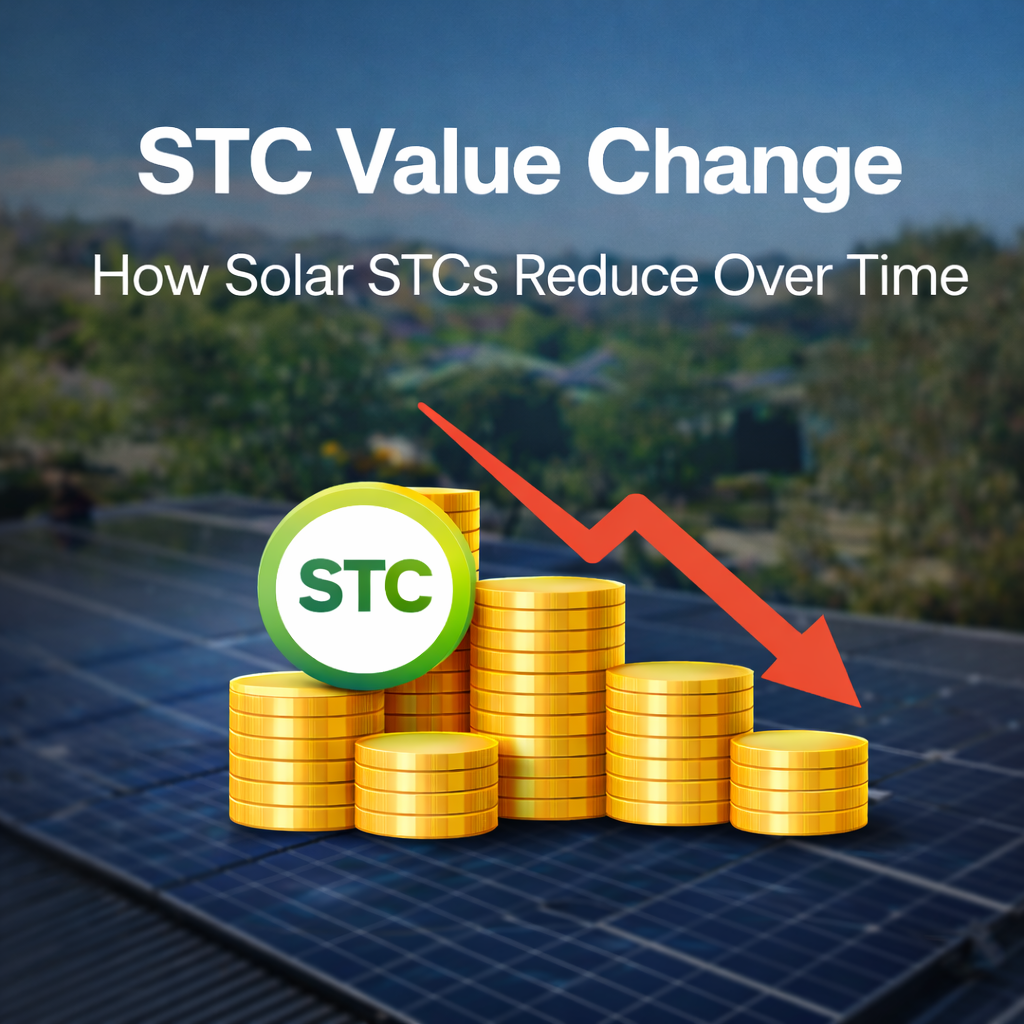
How STC Values Change Over Time
Why people get confused about “STCvalue”
When people say “theSTC rebate is dropping”, they often mean two different things.
· The number of STCs a new system can create can reduce over time because the deeming period steps down.
· The dollar value per STC can move because STCs are traded.
Understanding the difference helps you make sense of headlines and makes quote comparisons much easier.
The STC count steps down over time
For solar PV systems,the number of certificates you can create is tied to a deeming period. That period reduces over time as part of the scheme design.
The practical effectis straightforward: all else equal, a system installed later may create fewer STCs than the same system installed earlier.
In plain terms, the scheme assumes a solar system will generate renewable energy benefits over aset number of years. Each year, that assumed period steps down a little. Fewer years means fewer certificates.
You will often hear that the deeming period reduces by one year each year until the step-downcompletes. The exact schedule is set by the scheme, so it is worth confirming the current rules when you are close to installing.
A simple example to make it concrete
Say two households install the same sized system in the same location, but one installs earlier and one installs later after a step-down. The later system can create fewer STCs, which means a smaller discount if the STC price is similar.
That does not automatically mean the later household made a bad decision. Electricity prices, feed-in tariffs, and household usage might have shifted in the meantime. The step-down is just one piece of the puzzle.
Location affects the STC count too
STC calculations use zones to reflect different expected solar generation in different parts of Australia. That means the same system size can attract a different STC count indifferent locations.
This is one reason it is hard to compare “rebate amounts” between friends in different cities. It is better to compare system quality and on-site usage than to chase a single headline discount.
The dollar value per STC can move
STCs have a market value because they are traded. That means the dollar value used in quotes canchange.
Many installers use a conservative STC price in quotes to reduce surprises. Some lock in the STC price for a period. If you are comparing quotes, ask what price has been assumed and when it is locked.
You may also hear mention of an STC clearing house. The clearing house provides a pathway for STCs to be sold at a set price mechanism, but it can involve waiting periods. Many businesses trade STCs through the open market, which is why quote assumptions can vary.
For homeowners, the practical action is to ask the installer how they have priced STCs and whether the discount is guaranteed.
Which date matters for STCs
Homeowners sometimes assume the date they sign a quote locks in the STC value. In most cases, the installation date is what matters because STCs are created for an installed and commissioned system.
If you are close to a step-down date, it is worth discussing scheduling and realistic installation timeframes. A reputable installer will not promise an impossible timeframe just to win the job.
What this means for homeowners deciding when to install
It is natural to wonder whether you should rush to install before the incentive reduces. In practice, the decision is usually bigger than the STC step-down.
Good reasons to movesooner include:
· You are already paying high electricity prices and your roof is suitable.
· You are planning electrification upgrades and want solar in place first.
· You want to lock in a design before changing tariffs or export conditions.
Bad reasons to rush include signing with an installer you do not trust, or accepting a poor design just to chase a deadline.
How to compare quotes across time
If you are comparing aquote you received last year to one you receive now, differences in STC discount might not be a sign that someone is ripping you off.
To compare fairly, ask for the same system size and similar assumptions, then compare:
1. System design and roof allocation
2. Included electrical work and compliance
3. STC price assumption and lock-in timing
4. Warranties and monitoring access
Decision traps to avoid
· Assuming a bigger STC discount automatically means a better system. Design quality still matters more.
· Chasing a deadline and ignoring roof shading, exportlimits, or future upgrade plans.
· Comparing quotes with different system sizes or different STC price assumptions and treating it as apples-to-apples.
If you keep the comparison clean and focus on long-term fit, the STC changes become manageable rather than stressful.
How to protect yourself when STCs arechanging
1. Ask for the STC price assumption in writing.
2. Ask when the STC price is locked in and what happens if the market moves.
3. Confirm the expected installation timeframe and whether any step-down dates may apply.
4. Compare quotes on design quality and include delectrical work, not just discount size.
If you do these four things, STC changes over time become a normal planning factor rather than asurprise.
Bottom line
STC benefit changes over time for two reasons: the number of certificates reduces as the scheme steps down, and the value per certificate can move with the market.
Use the incentive as one input, not the only input. The strongest long-term value still comes from good design and correct installation.

How the Federal Solar Rebate (STCs) Works
STCs are the reason your quote has an upfront discount
When Australians talk about the federal solar rebate, they are usually talking about Small-scale Technology Certificates, or STCs.
The key point is that STCs are not a cash payment sent to you after installation. In most cases, they are converted into an upfront discount on your solar quote.
What STCs actually are
STCs are certificates created when an eligible small-scale renewable energy system is installed. They represent the environmental benefit of producing renewable energy under the federal scheme.
Your system can create a certain number of STCs based on its size, location, and installation date. Those certificates have a market value.
The most common STC pathway for homeowners
Most households use the simplest pathway: assign the STCs to the installer or their agent in exchange for an upfront discount.
The process usually looks like this:
1. You receive a quote that shows a price after STCs.
2. You sign a form agreeing to assign the STCs for your installation to a registered agent.
3. The system is installed and commissioned with the required documentation.
4. The agent creates and trades the STCs, and the value is already reflected in your invoice.
From the homeowner’s point of view, the STC process is mostly paperwork. The real impact is the discount you see on the quote.
Can you keep the STCs yourself?
In theory, the system owner can choose to keep the STCs and sell them independently. In practice, most homeowners do not because it adds complexity and delays the benefit.
Assigning STCs to the installer or a registered agent is popular because it turns the incentive into an immediate discount. It also means the agent manages the certificate paperwork and trading process.
If you are curious, ask your installer what the price difference would be if you did not assign STCs. The answer will help you understand how the discount has been calculated.
Eligibility: what makes a system STC-eligible
STCs are not available for every setup. Eligibility depends on system type, size, and compliance.
· The system must be an eligible technology under the scheme.
· It must be installed to the required standards and paperwork requirements.
· The installation must be completed by appropriately accredited people and recorded correctly.
From a homeowner’s point of view, the practical takeaway is to use a reputable installer who can clearly explain compliance and documentation.
Why the STC number is different in different locations
Australia is divided into zones for STC calculations. The zones reflect differences in expected solar generation across the country.
This is why a system of the same size can create a different number of STCs depending on where it is installed.
Installation date matters: the deeming period steps down
The number of STCs a system can create is linked to a deeming period that reduces over time. This is one reason the STC benefit changes year to year.
The scheme is designed to taper. That does not mean you should rush into a decision, but it does mean that quotes can change across years even if the hardware looks similar.
Why the STC discount varies between quotes
Two quotes for similar systems can show different STC discounts because installers may assume different STC prices.
Some installers lock in an STC price. Others provide an estimate that can change if the market price moves before installation. Ask what price has been assumed and when it is locked.
A note on STC prices and the clearing house
STCs are traded, sothe value used in quotes is linked to the market. There is also a clearing house mechanism in the scheme, which is one reason you may hear certain “reference” prices mentioned in the industry.
For most homeowners, the practical implication is simple: make sure your quote states the STC price assumption and when it is locked in.
The paperwork you will usually sign
Most installers will ask you to sign an STC assignment form as part of the contracting process. You may also be asked to confirm identity details, ownership details, and installation address information.
Keep copies of signed documents. It is boring admin, but it protects you if there are questions later about eligibility or system details.
A quick owner checklist after installation
1. Save the final invoice showing the STC discount.
2. Save compliance certificates and commissioning paperwork.
3. Record panel and inverter model details and serial numbers.
4. Make sure monitoring access details are handed over properly.
This makes future warranty claims, upgrades, or property sale questions much easier.
What you should check in your quote
· Does the quote show a price before STCs and after STCs?
· Is the STC price assumption stated?
· Is the STC discount locked in at signing or at installation?
· Is the system design suitable for your roof and export limits, not just sized to maximise STCs?
A clear quote makes the STC component easy to understand. If it is vague, ask for clarification in writing.
What happens if you change your mind
If you cancel a job before installation, the STCs are not created, so there is usually nothing to unwind beyond normal contract terms.
If you change system size or design before installation, the expected STC amount can change because certificates depend on system size and installation date.
Common STC pitfalls to avoid
· Quotes that do not clearly show before and after STC spricing.
· Unclear timing on when the STC price is locked in.
· Designs that chase certificates but ignore export limits or shading.
· Missing handover documents, making future upgrade sharder.
If you keep your paperwork and insist on clear quote assumptions, the STC component should be straightforward.
What happens if you upgrade or expand later
If you add panels or replace major components later, STC handling can change depending on what is being installed and how the system is reconfigured.
The safest approach is to keep your original system documentation and talk through upgrade plans with your installer before buying additional equipment. A good designer will consider export limits, inverter capacity, and compliance implications, not just panel count.
Bottom line
STCs are a federal incentive that usually shows up as an upfront discount. The best way to protect yourself is to make sure your quote clearly states how STCs have been appliedand what assumptions have been used.
Coming soon...