NSW Solar & Battery Rebates Guide 2026
Learn how the NSW solar rebate and NSW battery incentive work in 2026. Understand STCs, VPP programs, export limits and what affects your real savings.

Is there a separate NSW Government rebate?
And are NSW battery incentives actually worth it?
In short:
This guide explains how the NSW solar rebate and battery incentives actually work in 2026 — and how to assess them properly before committing to installation.
When someone searches for a “NSW solar rebate”, they are usually referring to the federal Small-scale Renewable Energy Scheme, not a separate NSW Government cash rebate.
There is currently no broad statewide NSW Government solar panel rebate layered on top of the federal scheme for standard residential rooftop systems.
Most financial support comes from Small-scale Technology Certificates (STCs).
The Small-scale Renewable Energy Scheme operates nationally, including NSW.
When you install an eligible solar PV system:
You do not receive a cheque from the government.
Instead, your installer assigns the certificates and reduces your contract price accordingly.
That is why most NSW solar quotes already show a discounted price.
The value of STCs depends on:
As a general example:
A typical 6.6 kW residential solar system in NSW may attract several thousand dollars in STC value in 2026. The exact amount changes year to year.
The scheme is legislated to end in 2030, and the number of certificates reduces annually. This means:
This phase-down is often overlooked in online comparisons.
At the time of writing, there is no standard statewide NSW Government solar cash rebate for typical residential installations beyond STCs.
However, NSW does operate related initiatives such as:
These are conditional and depend on configuration and eligibility.
Battery incentives in NSW are more complex than solar STCs.
There is no automatic national certificate scheme equivalent to solar. Instead, support is typically structured around:
Eligibility can depend on:
Battery incentives should not be assessed in isolation. Operating conditions matter.
Many NSW battery programs are linked to Virtual Power Plant participation.
A VPP allows distributed batteries to:
In return, participants may receive:
However, VPP participation may involve:
Understanding these conditions is critical before enrolling.
NSW includes multiple distribution networks:
Each has different:
For example, some areas limit export to 5 kW per phase, while others allow higher export with dynamic control.
This affects:
Many generic rebate guides ignore this layer entirely.
Understanding incentives without understanding tariffs gives an incomplete picture.
Common NSW tariff structures include:
Battery value changes significantly depending on tariff structure.
If evening peak rates are much higher than daytime rates, batteries can:
NSW feed-in tariffs have declined over time. Lower export rates increase the value of self-consumption — but not necessarily oversized systems.
Financial modelling should consider:
For most households, solar remains financially beneficial in 2026 — particularly with rising electricity prices.
Battery economics depend more heavily on:
A battery may improve outcomes for households planning:
But not every property benefits equally.
In many cases, yes.
A typical NSW homeowner can:
Eligibility depends on:
Not all systems automatically qualify.
One of the most common mistakes in NSW is oversizing systems purely to increase certificate value.
Incentives reduce upfront cost — they do not guarantee performance.
Poorly designed systems can lead to:
Incentives should support good design — not dictate it.
Solar and battery systems are increasingly integrated with:
Designing for future electrification often changes optimal system size today.
A properly planned system:
To access solar rebates in NSW and battery incentives, systems generally must:
Battery programs may also require:
Administrative accuracy matters.
At Decarby Solar, incentives are treated as one input in a broader engineering process.
System sizing is based on:
For NSW projects, we:
The focus is long-term performance — not short-term rebate chasing.
The term “NSW solar rebate” suggests a simple government payout. In reality:
The real questions are not just:
But also:
A well-designed solar and battery system in NSW should deliver performance first.
The rebate should simply make that decision easier.
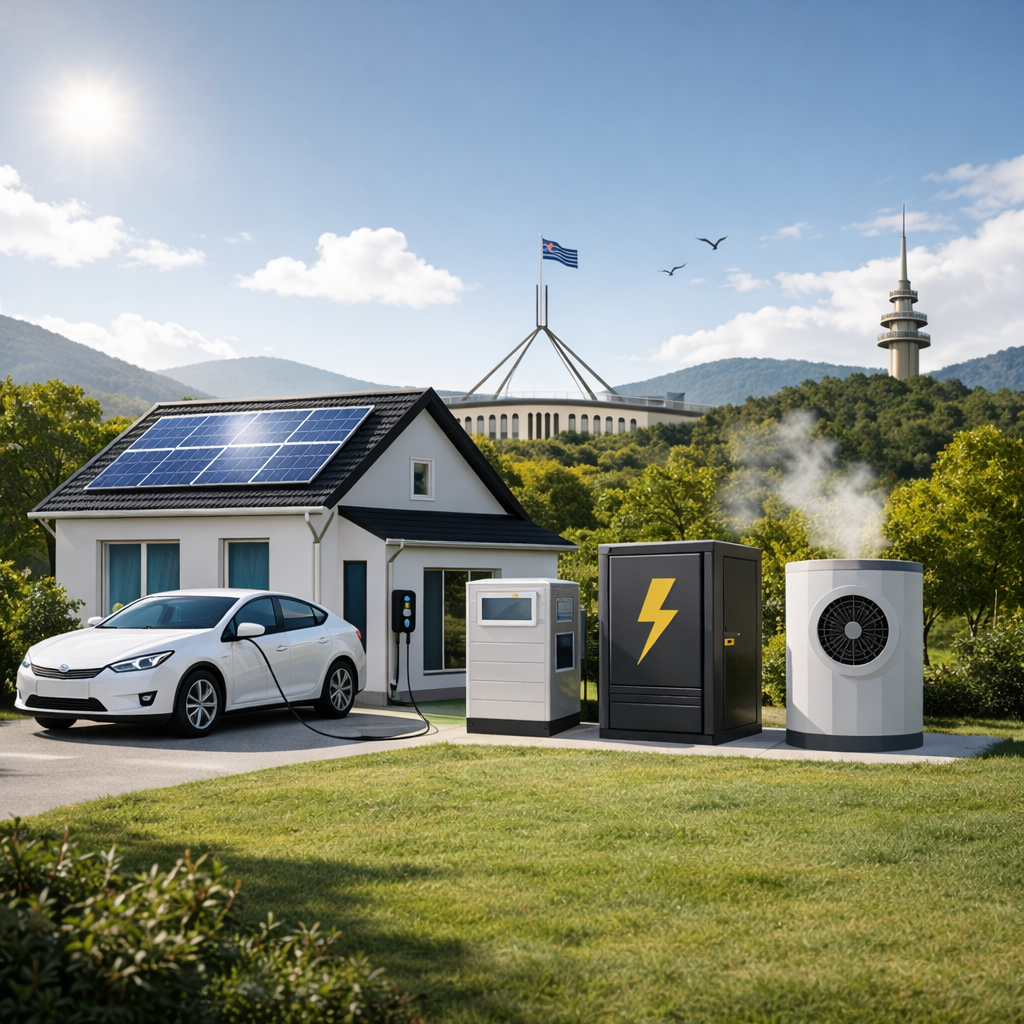
Home electrification is accelerating across Canberra. Solar panels, battery systems, heat pump hot water and EV chargers are becoming standard upgrades for households moving away from gas. One of the key enablers behind this shift is the Brighte ACT loan, delivered under the ACT Government’s Sustainable Household Scheme.
If you are researching how the Brighte ACT loan works, what it covers, and how it fits into a broader energy upgrade plan, this guide explains it clearly and practically.
The Brighte ACT loan is the finance mechanism used to deliver the ACT Government’s Sustainable Household Scheme.
It is:
It is important to clarify that this is not a rebate. It is a finance arrangement that allows you to spread the cost of approved upgrades over time, subject to credit approval and scheme conditions.
If you are unsure how loans differ from rebates or federal incentives, our article on ACT solar rebates and ACT battery rebates explained provides useful context around how different support mechanisms interact.
The Sustainable Household Scheme supports a range of approved electrification upgrades. Eligibility and product lists are subject to current ACT Government guidelines.
Common eligible categories include:
Solar remains one of the most common uses of the Brighte ACT loan. If you are still assessing system size, our solar system size guide for Australian homes explains how to determine the right capacity based on household usage.
Before financing a battery, it is worth reviewing whether storage aligns with your usage profile.
Hot water can represent a significant portion of household energy use. Electrifying this load is often one of the first steps in reducing gas reliance.
If you are planning to charge from solar, careful integration matters. Our EV charger installation service page outlines key considerations for safe and compliant setups.
Eligibility for the Brighte ACT loan typically depends on:
The scheme also includes maximum loan amounts. These caps can influence how solar systems and batteries are designed, particularly for larger homes with higher electricity demand.
Because this is a finance product, credit approval is required. Loan terms, repayment structures and fees are set out in the finance agreement.
A defining feature of the Brighte ACT loan is its zero-interest structure. You repay the amount borrowed without added interest, subject to the loan terms.
Key considerations include:
Although there is no interest component, it remains a loan obligation. It is important to assess whether repayments align with your broader financial plans.
The Brighte ACT loan is separate from federal solar incentives such as Small-scale Technology Certificates.
STCs reduce the upfront cost of eligible solar systems. They are applied before finance is calculated, which can lower the total amount required under the loan.
If you want a detailed explanation of how STCs work, our article on federal solar incentives explained in Australia breaks down how certificates are calculated and applied.
Understanding the difference between:
helps avoid confusion when comparing options.
Loan caps often influence system design decisions.
It can be tempting to simply size a system to the maximum allowable loan amount. In practice, effective design should be based on:
Oversizing without analysing usage can lead to underutilised generation. Our article on why bigger solar systems are not always better explains why careful system design often delivers betterlong-term outcomes than simply installing the largest possible array.
At Decarby Solar, discussions around the Brighte ACT loan often begin with finance questions but quickly shift to system planning. Many ACT homeowners are looking to combine solar, battery storage and heat pump hot water into a staged electrification plan. Designing within scheme limits while maintaining performance requires practical installation experience and a clear understanding of ACT compliance requirements.
For many households, the loan is not just about installing solar. It is part of a longer-term shift away from gas.
Common staged upgrade pathways include:
Taking a whole-of-home view can help avoid stranded gas infrastructure and repeated electrical upgrades.
If you are exploring this pathway, reviewing related topics such as solar sizing, battery economics and incentive structures can provide clarity before committing to finance.
A balanced assessment is essential before proceeding.
The loan may suit homeowners who:
It may be less suitable for those who prefer to avoid finance entirely or who plan to sell in the near future.
Each household’s situation differs. Energy usage, roof configuration, switchboard capacity and long-term electrification plans all influence whether a Brighte ACT loan is appropriate.
When approached thoughtfully, the combination of structured finance and well-designed energy systems can support a practical transition toward a more efficient, all-electric home in the ACT.

The ACT has taken a different approach to clean energy incentives compared to most Australian states. Rather than relying on large, permanent cash rebates, the Territory supports solar panels, battery storage, and household electrification through targeted programs, structured finance, and long-term energy policy.
For homeowners and businesses, this can make ACT solar rebates and ACT battery rebate options harder to understand at first glance. This guide explains how current incentives work in practice, what support maybe available, and how they fit into real solar, battery, and electrification projects across Canberra and the ACT.
This article is intended as general information only. Program availability, eligibility criteria, and funding limits can change overtime.
There is currently no universal ACT solar rebate that applies automatically to all households. Instead, solar support in the ACTis delivered through a mix of:
Some ACT programs are designed for specific household types, such as concession card holders or lower-income households, rather than the general population.
This means that while many households can still access financial support, eligibility is not guaranteed and must be assessed on acase-by-case basis.
Although not ACT-specific, the federal Small-scale Technology Certificates (STC) scheme remains one of the most important solar incentives for ACT homeowners.
Under the STC scheme:
STCs are not an ACT government rebate, but they significantly reduce the upfront cost of most residential solar installations in Canberra and surrounding areas.
The ACT has historically supported battery storage through structured incentive programs rather than direct cash rebates.
These programs are typically designed to:
As a result, when people search for an ACT battery rebate, they are often referring to interest-free or low-interest battery loan schemes rather than a traditional rebate.
ACT battery incentive programs have commonly included features such as:
Availability can change depending on funding rounds and policy priorities. Some programs focus on homes that already have solar installed, while others may allow batteries as part of a broader electrification upgrade.
Because of this variability, battery eligibility should always be confirmed before system design or installation begins.
For homes with existing solar, adding a battery involves more than choosing a battery size. Incentive eligibility can be influenced by:
Designing a battery system around incentives alone can create limitations lator. Long-term performance and flexibility should remain the priority.
The ACT has committed to transitioning away from fossil gas in homes and buildings. As part of this policy direction, electrification incentives may apply to upgrades such as:
These incentives are often delivered through loan schemes rather than rebates, sometimes bundled with solar or battery installations to improve overall household efficiency.
In many cases, ACT incentives are designed to complement each other rather than operate in isolation. A household may be able to combine:
This approach can improve energy independence and reduce long-term energy costs, even if individual rebates are limited.
Feed-in tariffs are not government rebates, but they remain part of the overall solar value equation.
In the ACT:
While feed-in tariffs are generally modest, they still contribute to system payback and should be factored into solar system design decisions.
Eligibility requirements differ between programs, but common criteria include
Not all households will qualify for every incentive. Understanding eligibility early helps avoid delays, redesigns, or rejected applications.
Incentives can influence more than just price. Theycan affect:
Designing a system purely to access a rebate can result in undersized or inflexible systems. In many cases, the best long-term outcome comes from prioritising energy needs first, then applying incentives where appropriate.
Decarby Solar works with ACT homeowners and businesses to design solar, battery, and electrification systems that align with current ACT rebate programs and incentive schemes without compromising system quality.
Rather than treating ACT solar rebates or ACT battery rebate programs as the main driver, Decarby Solar focuses on accurate energy assessment, compliant system design, and future-ready solutions. This includeschecking eligibility, understanding program conditions, and ensuring installations meet ACT network and safety requirements.
This practical approach helps customers avoid common issues such as incentive-driven design compromises, approval delays, or systemsthat fail to deliver long-term value.
Before proceeding with a solar, battery, or electrification upgrade in the ACT, it is worth confirming:
Professional guidance can reduce risk and ensure the system performs well beyond the incentive period.
ACT solar rebates, ACT battery rebate programs, and electrification incentives can play a useful role in reducing upfront costs, but they are not a substitute for good system design.
Programs change, funding limits apply, and eligibility is not guaranteed. A well-designed solar and battery system should make sense on its own, with incentives treated as a bonus rather than the foundation of the decision.
For ACT households planning long-term electrificationand energy independence, understanding how these incentives work together is animportant first step.